Rural Enterprise and Economic Development in Southern Africa

For the youth..
..and for the future

Who are we and what do we do?
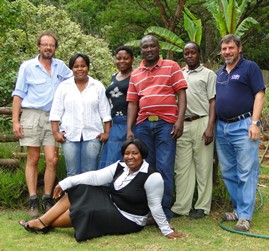
We are a team of Africans of all shapes, sizes and colours that have travelled a bumpy, living lab and action-learning road from being technologists to becoming social-enterprise developers, from developing and providing (ICT) systems for development to a “development through enterprise” approach with warm-blooded, technology-equipped, human networks. In our world multi-purpose and integration are important ingredients for sustainability – which means that service delivery, in rural areas specifically, should cater for economies of “scope” and not economies of “scale”. This view has the added benefit that it provides for a wide range of services over the same cost structures.
How do we do it?
Our networks are mostly deployed in the contexts of local or traditional authorities and for this reason we have also developed a decision framework for local economic and enterprise development (LEED) planning. This focus is also reflected in our name REEDiSA: Rural Economic and Enterprise Development in Southern Africa. Our systemic approach finds the sweet spot in the overlapping fields of human-behaviour (“People”), enterprise development (“Organisation”), the geographical and historic contexts ("Environment") and technology application (“Technology”) - shown in the "POET Model" video on this page.
Changing the way we feed ourselves
We are currently very active in the emerging agriculture arena where we are combining our youth network approach and learning with Fresh Life Produce’s vertical growing technology to address nutrition, food security and agro-enterprise needs.
We also doing this with Magabagabe Holdings in the (rural) Limpopo Province of South Africa.

What Do We Do Specifically?

Our team has more than 200 combined years of experience as social and corporate entrepreneurs in the research, development and implementation (RDI) of technology-intensive and science-rich solutions for “development-through-enterprise” efforts in Southern Africa, acknowledging and incorporating the indigenous knowledge systems of the local people.

What?

Self-sustaining, multi-sphere Social Enterprise networks to support “development through enterprise” in Southern Africa

We see an entrepreneur as someone who:

• Identifies opportunities—spots unmet needs, inefficiencies, or new possibilities.
• Mobilises resources—brings together capital, labour, ideas, and networks.
• Takes on risk—commits their time, money, and reputation without guaranteed outcome.
• Creates value—builds products, services, or systems that didn’t exist before or improves existing ones.
• Drives change—often disrupts or transforms industries, communities, or ways of working.

In short:

An entrepreneur is therefore a creator of value who takes initiative and risk to bring new ideas into reality.


How?

Design, implement, enable and support networks of (young) social entrepreneurs in various under-serviced areas of Southern Africa in a manner that:

⦁ Provides reach extension for public, private and non-profit organisations to deliver products and services to the base of the pyramid (BoP);
⦁ Formalises, captures, enhances and distributes indigenous knowledge and learning concerning, and originated by, socio-economic networks in under-serviced communities to enable these networks to function more effectively and to participate in both the knowledge and broader national economy; and
⦁ Provides a broad export & import channels for products and services from and to these communities.

Why?

Oor "Why" has multiple dimensions and responses:

* It is firstly In response to tasks in both the 1st and Great Commissions that are commanding us to be custodians of creation and to disciple others to do the same; and

* It is secondly a response to a further refined commission to learn how to bring wholeness to people and teach them to pass this wholeness on so that justice can reign on earth and those at the fringes of our world can be brought into the centre.